Articles
Redesigning to Reduce: Genesal Energy Renews its Commitment to Ecodesign
19 Marzo - 2026
There are decisions that go unseen. They do not alter equipment output or change its external appearance, yet they shape its impact for years to come. Ecodesign is one of them.
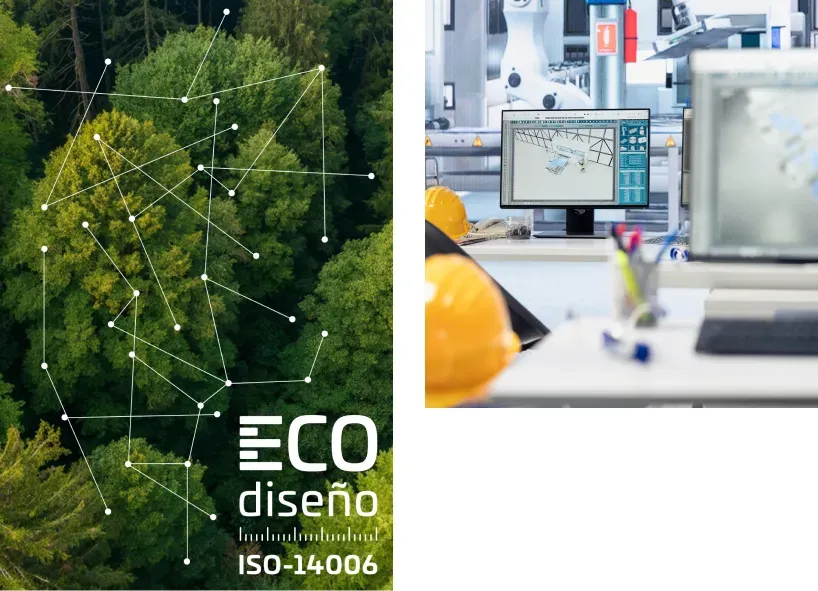
For this reason, Genesal Energy has renewed its certification in accordance with ISO 14006, the standard governing the integration of ecodesign within environmental management systems. This milestone has not been approached as a mere formal validation of an already implemented system, but as a technical review of the product design process, aimed at broadening its scope, increasing the level of environmental analysis detail, and improving the quality of the data used in decision-making.
The real value of the certification lies in how the internal evaluation process is structured, which criteria are applied, and how the decisions adopted are documented.
ISO 14006 does not certify a specific generator set model nor validate a particular environmental outcome. Its purpose is to ensure that the environmental variable is systematically integrated into the design and development phase. Therefore, the real value of the certification lies in how the internal evaluation process is structured, which criteria are applied, and how the decisions adopted are documented.
In this cycle, the work has focused on strengthening the analytical methodology applied to selected generator sets, reviewing components, materials and processes from a technical and quantitative perspective. The approach has been distinctly engineering-driven: identifying where genuine impact reduction potential exists, quantifying it using consistent criteria, and validating any modification without compromising equipment reliability.

Integrating Environmental Analysis into Product Engineering
In complex industrial products, the design phase structurally determines a significant portion of the environmental impact associated with the life cycle. Although, in a generator set, the use phase represents a considerable share of total emissions, design decisions influence material selection, overall equipment mass, required production processes, and the logistical configuration of the supply chain.
The renewal of ISO 14006 has involved expanding the number of components analysed within the project scope and deepening the environmental characterisation of each. The assessment has gone beyond identifying the primary material of a part, considering instead its specific composition, supply origin, required transformation process, and associated logistics model.
To this end, a more detailed Life Cycle Assessment (LCA) has been developed compared to the previous phase. Environmental databases have been reviewed, emission factors updated, and production scenarios adjusted to more accurately reflect real manufacturing and supply conditions. This work has enhanced data traceability and reduced uncertainty margins in the quantification of emissions associated with each component.
The adopted approach is based on a clear premise: integrating environmental criteria does not replace traditional technical requirements in industrial design, but rather incorporates them as an additional variable in the decision-making process. In a generator set designed to operate in critical environments, reliability is non-negotiable. Any modification in material, geometry or process must first be validated in terms of mechanical strength, thermal behaviour, durability and maintenance requirements.
The renewal of ISO 14006 certification consolidates ecodesign as an integral part of the engineering process at Genesal Energy.
Based on the analysis conducted, several types of interventions have been identified. In some components, environmental improvement was achieved by replacing conventional materials with recycled alternatives or materials with a lower carbon footprint, provided their structural performance was equivalent. In other cases, the production process itself was modified, incorporating in-house manufacturing through 3D printing. This decision eliminated intermediate stages, reduced transport requirements, and simplified the transformation chain, resulting in associated emission savings.
Certain geometries were also reviewed to optimise material usage, reducing mass without affecting structural integrity. This type of action has a direct effect both on material-related impact and logistics, as reduced mass may proportionally decrease emissions in subsequent phases.
It is important to note that not all evaluated components were modified. The applied methodology does not assume that every part must be redesigned, but rather that changes should only be implemented when environmental improvement is quantifiable and compatible with the product’s technical standards. In some cases, the analysis concluded that substitution did not generate significant reduction or introduced unnecessary technical risks. In such instances, the original configuration was maintained.
Quantified Results and Scope of Improvement
The comparative analysis between the original configuration and the optimised configuration of the modified components shows a 92.14% reduction in environmental impact associated with those specific parts. This percentage refers exclusively to the scope of the redesign project and not to the generator set as a whole, whose overall environmental performance largely depends on the use phase.
The significance of this result lies in demonstrating the room for action available at the design stage when analysis is carried out with sufficient detail. The optimisation was not based on isolated adjustments or general estimates, but on the systematic review of materials, production processes and logistics associated with each selected component. The percentage achieved is therefore the direct outcome of technical decisions supported by specific Life Cycle Assessment calculations.
Integrating environmental criteria does not replace traditional technical requirements in industrial design, but rather incorporates them as an additional variable in the decision-making process.
From a methodological standpoint, this reduction does not derive from theoretical average factors, but from an individualised study of each part, using updated environmental databases and consistent quantification criteria. The comparison was conducted under coherent assumptions between the baseline and optimised scenarios, ensuring result consistency and traceability.
Although the total environmental impact of a generator set is strongly influenced by its operation, acting at the design stage allows for structural improvements that remain embedded in the product throughout its service life. The reduction achieved in the redesigned components does not depend on external variables or usage patterns; it is intrinsically integrated into the product’s construction.
Furthermore, this type of intervention offers scalability potential. The solutions adopted for the analysed components can be systematically incorporated into future units or adapted to other configurations, progressively extending the scope of environmental improvement within the product development process.

Conclusion
The renewal of ISO 14006 certification consolidates ecodesign as an integral part of the engineering process at Genesal Energy. Beyond regulatory compliance, the work undertaken has strengthened the internal environmental analysis framework, improved data quality, and expanded the scope of interventions on specific components.
The work has focused on strengthening the analytical methodology applied to selected generator sets, reviewing components, materials and processes from a technical and quantitative perspective.
The outcome goes beyond a declaration of intent; it materialises in quantified emission reductions embedded within the product itself. The 92.14% reduction in the modified components demonstrates that there is genuine room for improvement at the design stage when systematic and technically validated criteria are applied.
The process is not considered closed. The implemented methodology allows for the progressive inclusion of new components into the analysis, the updating of emission factors as databases evolve, and the review of design decisions in line with technological advances or regulatory changes. In an industrial environment where traceability and emission reduction are becoming increasingly relevant, having a structured system to integrate environmental analysis into product engineering constitutes a key tool for ensuring consistency and continuous improvement.

Rellena el formulario con tus datos si quieres uno de nuestros grupos electrógenos o tienes dudas. Elaboraremos un presupuesto a tu medida.
Teléfono/Fax de atención al cliente:
+34 900 730 124
Mail equipo atención al cliente
consultas@genesal.com