Articles
Genset alternators - The perfect engine match
26 Enero - 2026
Genset alternators
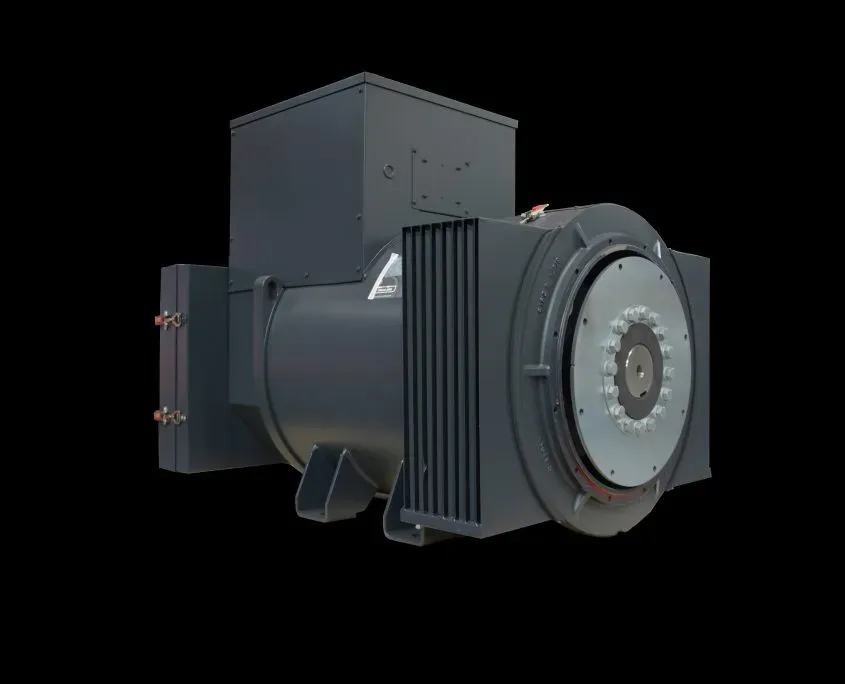
Alternators in Generator sets are devices capable of transforming mechanical energy into electrical energy which is used by the loads connected to the generator, obtaining in this way the necessary current for optimal operation.
It is a key component of any equipment and the device that best complements the engine. Having a specific alternator adapted to the needs o each equipment is important precisely for this reason.
Not all alternators are the same and must be perfectly matched to the generator to get a perfect engine-alternator tandem as a result.
Characteristics de los alternators
Connection, isolation and maintenance
There are several factors to be considered among the characteristics of alternators:
Voltages and frequencies
The frequency of the alternator will depend on the rotation speed of the diesel engine and the number of poles. The engine is chosen based on these parameters so that the energy generated is at the area’s usual grid frequency. The following frequencies are used:
- 50 Hz: Common in Europe, most of African countries, Australia, China and part of South America.
- 60 Hz: Usual in the United States, Canada, and part of Latin America.
Within these frequencies, we can find a varied range of voltages and depending on which one is selected, it will condition the model and type of connection of the alternator, both in low and medium/high voltages.
Usual voltages
The usual three-phase connections for low voltage are the following:
- 50Hz: 400/230V 3F+N
- 60Hz:
- 480/277V 3F+N
- 440/254V 3F+N
- 380/22V 3F+N
- 220/127V 3F+N
Connection types
There are several options for connection depending on:
Number of phases:
- Single-phase
- Three-phase
- Split-phase
Alternator configuration:
- Configurations with accessible neutral: star connection.
- Configurations without accessible neutral: delta connection.
Number of wires:
- 6 wires: it allows reconnections between star and three-phase delta. The obtained voltages will be just the nominal three-phase voltage when reconnecting in delta.
- 12 wires: it allows single-phase split-phase reconnections (double delta or single-phase zig-zag), three phase (series star, parallel star, series delta, parallel delta, zig-zag), being able to obtain a wide range of nominal voltages.
In general terms, the most common and versatile model is the 12-wire one since it allows reconnection in both star and triangle.
How should alternator treatment and maintenance be?
Among all the factors that can affect the alternator and impair the operation of the generator set, the ones that most stand out are the exogenous factors. Altitude, extreme climates (too arid or too humid) or marine corrosion itself are the alternator’s great enemies.
To avoid damages, there are several treatments specifically designed to protect the devices, including tropicalized and marinated, which, as their names indicate, are prepared for very adverse climates.
However, all systems share the same goal no matter which one is chosen: to protect both the alternator winding and the insulated parts against rust, water, friction, high temperatures, etc.
Classes of insulation
There are 3 classes of insulation of primary interest for engines and alternators according to AINSI, IEEE, and NEMA standards.
- Class H: Maximum admissible temperature 180 °C
- Class F: Maximum admissible temperature 155 °C
- Class B: Maximum admissible temperature 130 °C
For low voltage alternators, the most common insulation level is class H, whereas for medium/high voltage, we find F or H insulation levels on a regular basis.
A class H insulation level alternator has the same service life as a class F alternator as long as they operate at a rated temperature. If the alternator operates with a class F temperature rise (less power is required), the alternator life will be increased. The service life of a class H alternator with temperature rise F will be similar to that of a class F alternator with temperature rise B.
The most common insulation level in low voltage is class H, whereas in medium voltage insulation level F is usual. Providing an alternator with insulation level H will reduce its size as it is possible to give the same power with a smaller alternator size.
Winding pitch
There are 2 common winding steps in alternators:
2/3: this winding step is the usual one in low voltage alternators. It allows reducing the harmonics multiples of 3 that cause overheating of the neutral. This harmonic occurs mainly with single-phase loads, so when using an alternator with a low voltage winding pitch, we make sure that the harmonic load of the neutral is reduced.
5/6: this winding step is usual in medium or high voltage alternators, in which the neutral is not usually distributed. It allows the alternator to be of a smaller size than in the case of a 2/3 pitch with the same power.
Excitation system and alternator regulation system (AVR)
There exist several types of alternator excitation systems. These are the best known:
SHUNT: It is the most basic system as it takes the power for the voltage regulation card directly from the main winding. It has almost no short-circuit capacity since when an impact is applied and a voltage drop occurs, the voltage regulation is also reduced, so response will be slow and voltage transients will be long.
Auxiliary winding In this system, the alternator includes an auxiliary winding to feed the voltage regulation card, so that in the event of load impacts, the voltage that feeds the regulation card will not be affected. Response will be faster, with short-circuit capabilities of 3 times the rated current for 10 seconds. This regulation system is the most common due to the cost / performance ratio.
PMG (Permanent Magnet Generator): in this system, the alternator includes a permanent magnet connected to the mechanical shaft as a second generator. This generator is the one that feeds the voltage regulation card, so the voltage regulation card will be totally independent from the alternator itself. The short circuit capacity is similar to the auxiliary winding option. This alternative is suitable especially when there is a large number of harmonics in the installation that can affect the alternator.
Rellena el formulario con tus datos si quieres uno de nuestros grupos electrógenos o tienes dudas. Elaboraremos un presupuesto a tu medida.
Teléfono/Fax de atención al cliente:
+34 900 730 124
Mail equipo atención al cliente
consultas@genesal.com